homepage & index


www.classicbikes.co.uk

Machine of the month!

homepage & index


"Machine of the month" is our website's magazine page. Please scroll down the page to find Rod Ker's latest ramblings! Or follow the LINKS below to other articles (for more of the same);

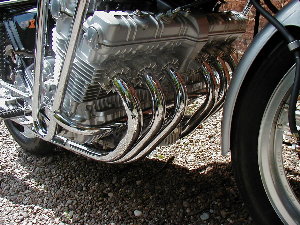
- Kawasaki Z1-Z900 - Class of '76: Laverda Jota v Kawasaki Z900  - Kawasaki 500 Triples.  - L-Plate 250s   - Honda CBX1000

Kawasaki Z1 / Z900

Rod Ker time travels......back to 1972


It’s generally agreed that Honda’s CB750 four, launched in 1969, was the world’s first superbike. Surprisingly, it took another three years before a rival manufacturer produced a direct competitor (brief pause for fans of the Triumph Trident and BSA Rocket III to send irate e-mails to info@classicbikes.co.uk). The motorcycle in question was, of course, the Kawasaki Z1, which went on sale in America in 1972 and Europe in ’73.

1973 Kawasaki Z1 900 - a very rare original UK registered example in Candy Orange

1973 Kawasaki Z1 900

A very rare original UK registered example in Candy Orange (rear shocks are US spec.)

 
Kawasaki actually had a four-stroke 750 four in development when Honda dropped their bombshell. The project was promptly shelved to concentrate on the three-cylinder, ‘Green Meanie’ two-strokes, which came out at about the same time as the CB750 but sold to an entirely different type of person (lunatics, mainly). Unfortunately, noisy, gas-guzzling, polluting two-strokes were doomed even in the late Sixties, which meant that the triples had a limited life expectancy. Kawasaki knew that four-strokes would be the only type of engine allowed in the clean green future, so after a couple of years the R&D dept blew the dust off the plans of their still-born four.
 
Thus began the ‘New York Steak’ project, with ‘Ben’ Inamura heading the design team. Things happened quickly. Prototypes disguised as Honda CB750s were plying the roads of America by 1971, clocking up big mileages to make sure that everything was right first time.
 
Obviously, Kawasaki’s four would have to be more super than Honda’s, which basically meant bigger and more powerful. About a litre of displacement was envisaged initially, but the capacity actually settled at 903cc, maybe because they didn’t want to scare people too much. While both the Honda and Kawasaki used transverse four-cylinder power units installed in double-cradle frames, the details were rather different. The CB750’s long-stroke, 736cc plain-bearing engine used a pair of roller chains for primary drive, and had a single overhead camshaft running in separate carriers bolted to the top of the cylinder head. The valves were opened by rocker arms, with tappets adjustable by screws. Lubrication was dry-sump, oil being carried in a tank under the side panel, as on a traditional British bike.
Conversely, Kawasaki’s four stored its oil in the sump, and used a built-up roller bearing crankshaft, with gear primary drive. In some respects the bottom end therefore had a few things in common with the company’s two-strokes.
A central roller chain drove a pair of camshafts, effectively running in the cylinder head (in replaceable split shell bearings), opening the valves directly through bucket tappets, with clearances adjustable by shims. Honda’s 1967 CB450 twin had been the first generally available dohc bike engine, but such things had been common in the car world for decades. Most famously, Jaguars had used twin cam XK engines since 1948, and the Z1’s top end was actually quite similar in layout, except that it was cooled by air, not water, of course.

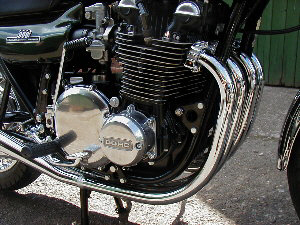
The 72  Z1 motor - a 903cc masterpiece of design excellence and visual beauty !

A 1972 Z1 motor - a true masterpiece

 (note plastic plug caps as fitted for the Italian market)

 
Breathing through a quartet of 28mm carburettors, Kawasaki claimed 82PS at 8500rpm -- which is a bit less than the 82bhp often quoted, incidentally. (Pferde Starke is the metric version of horsepower. 1PS = 0.9863bhp) The crucial bit was that this was about 15bhp more than the CB750! In terms of specific output, the two were therefore very close. The scaled-down 746cc Z2 produced for the Japanese market gave 69PS, possibly because it would have been unthinkable not to beat the CB750’s quoted 67.
 
Such an incredible engine needed an incredible chassis&ldots; Alas, the Z1 - or Super 4, as it was almost christened – didn’t really have one! There was some talk of the double-cradle frame being inspired by the Norton Featherbed, which was probably almost true, because every motorcycle made since the 1950’s must have been influenced by Norton’s frame to some extent, but this was totally irrelevant. Norton only had about 50bhp and 350lb to deal with, not 80bhp and a bike that would tip the scales at over 500lb. Seen in isolation, the Z1 frame looked very strong, with a well-braced steering head and swinging arm pivot. The spindly front forks, with their short sliders, were probably the weak link, but they were still about as good, or bad, as anything else around at the time.
 
Z1 imports to the UK began in 1973, just in time for the oil crisis, when petrol prices were leaping over 50p per gallon. The big four was designed to run on 2-Star, but it wasn’t the best time to launch the fastest motorcycle ever, all the same. Only 44 were sold in Blighty in the first year, which tended to indicate that £1200 motorcycles weren’t top of many shopping lists. There was more to it than that, though, because most of the people who wanted a Z1 couldn’t buy one at any price. Kawasaki made about 80,000 dohc fours in the first two years, but all the 750s were staying in Japan, while lucky Americans bagged most of the 900s.

1974 Kawasaki Z1A 900

1974 Kawasaki Z1A 900
Restored by Steve Smethurst and Classic Bikes Ltd.

(NB This is a US spec example which should not really have a seat strap!)

Shortage of supply also explains why there weren’t many road tests in British magazines. Agrati, the importer until Kawasaki UK set up shop, didn’t have a Z1 for press purposes, so Bike begged one from a dealer to do a comparison with a Honda CB750. They loved it! The only slight criticism was directed at the gearbox. Everything else was apparently just about perfect - including the handling, it’s interesting to note, in view of the bike’s later reputation.
After the evil antics of the triples, memorably called the fastest camel in the world by the same magazine, they were expecting trouble. But no: ‘The handling was perhaps the most impressive thing about the big machine, so much so that anyone who owns one might be well advised to take out the centre stand. It‘s just too easy to ground it.’ This test was written by someone who raced bikes, and he backed up his opinion with info on Kawasaki’s development programme, which included extensive track testing by Paul Smart and Yvon Du Hamel, who averaged managed to do 122 miles in an hour on a Z1. Smart was quoted as saying that the bike would have finished in the top ten at Daytona.
The summary couldn’t have been more complimentary: ‘Kawasaki have made what looks like becoming a classic machine. It’s both simple and elegant to the eye, and sophisticated in design. It is strong, a joy to ride and handles like a machine 200lb lighter. It’s incredibly fast, and, yes - safe.’ Some would disagree with the last point, but the bit about becoming a classic machine now seems more than a little prophetic.
 

1975 Kawasaki Z1B 900

A 1975 Kawasaki Z1B 900 in Candy Super Blue
Restored by Steve Smethurst and Classic Bikes Ltd.
(NB This is a US origin bike with UK spec. shocks fitted)

 
Motorcycle Mechanics tested a Z1B in 1974, recording a top speed of over 130mph and a standing quarter in under 12.5 seconds, although they seemed keen to play down the performance and preferred to concentrate on practicality. ‘One of the three best bikes I have ever ridden,’ the writer concluded after 2000 miles. The only complaints concerned the tyres and lights, and the fact that he didn’t have £1177 to buy a new Z1. Again, no problems with the handling.
Motorcyclist Illustrated was less enthusiastic, with comments about the suspension being ‘mediocrely average’, although the tester admitted that it was difficult to judge the handling due to terrible weather.
 
The Z1B carried on until 1976, when the Z900 arrived, listed at £1369. The name change didn’t reflect any radical changes, but some modifications changes had been made. Twin front discs were now standard, and the forks were stronger, which was good news. On the mechanical side, the Mikuni carburettors were now down to 26mm, partly accounting for a quoted loss of one horsepower. The real difference was probably greater. Meanwhile, weight was up by about 25lb, for reasons that weren’t entirely obvious. Motorcyclist Illustrated had a theory: ‘It seems that the secret lies in heavier gauge frame tubing all round..’ This may have explained a reported improvement in handling. In particular, high speed stability was much better, they reckoned.
 

1976 Kawasaki Z900A4


A 1976 Kawasaki in Diamond Dark Green
An Original UK registered bike with twin front disks- but note short US spec. rear mudguard often fitted in preference by UK owners.

 
The Z900 only lasted a year before being replaced by the Z1000, basically the same bike with a 1015cc overbore, 4-2 exhausts and some extra frame gusseting. Low speed torque was up but flat-out performance was down, despite a claimed increase in power to 83bhp at 8000rpm. MCI was back on the case in 1977, taking time to have a scoff at earlier praise of the Z1’s handling by road testers from other magazines, before saying that the Z1000 was much better, even if it was ‘no Ducati’.
 
Never mind Italian bikes, the main problem for Kawasaki by this stage was the arrival of competition from other Japanese manufacturers. Yamaha, Honda and Suzuki all offered tempting alternatives. In particular, the GS750 and later GS1000 made the Z1000 look like a has-been. The King may not have been quite dead yet, but the throne was definitely beginning to show signs of woodworm.
 
While standard Z1s and Z900s are the bikes most in demand now, mention should also be made of the 900LTD, often said to be the first ‘factory custom’. Designed and modified in America, using American add-ons, this rare (then and now, especially in the UK) model came with Morris mag wheels, a fat rear tyre and slash cut mufflers. Kawasaki really hit gold here, because other LTDs of various capacities became available later in the 1970s, and soon every other Japanese manufacturer was offering something similar.

1976 Kawasaki Z900Ltd

A 1976 Kawasaki Z900Ltd

Sold new in the USA this example is very original (note the after market K&N air filters)

 
Z1B 900 Specification
 
Engine: 903cc (66x66mm), air-cooled, DOHC 8-valve four, Mikuni VM28SC carbs (Z1A & B), 82HP @ 8,500 rpm 54.3ft-lbs @ 7,000rpm, five speed gearbox
Electrics: 12v alternator, points ignition
Frame Tubular, double-cradle
Dimensions: wheelbase 58.7 in, overall length 86.6 in (2200mm).
 Fuel capacity 4.2 US gal,
 Dry weight 511 lb (232 kg)

Original Handbooks and publicity material for Z1s

----------------------------------------------------------
 
By Rod Ker, February 2007.
 
Photos and text are copyright Classic Bikes Ltd. unless otherwise noted.
 
Did you enjoy reading this? Please e-mail us your views to rod@classicbikes.co.uk


Index and LINKS to previous articles (for more of the same);

- Kawasaki Z1-Z900 "Kawasaki's ‘New York Steak’ prototypes disguised as Honda CB750s were plying the roads of America by 1971, clocking up big mileages to make sure that everything was right first time.

- Class of '76: Laverda Jota v Kawasaki Z900

- Kawasaki 500 Triples. "If Hannibal Lecter practised dentistry, this is the sort of noise that would be coming from his surgery"!

- L-Plate 250s "Life was so simple for fledgling bikers back in the 1970s. Anyone capable of walking as far as the local No-Star dealer without tripping over his flares could buy a motorcycle, slap on a pair of L-plates, and wobble off into the traffic".

- Honda CBX1000 "If you don't know what a Phantom jet fighter sounds like, buy a Honda CBX and have a fiddle with the exhaust system"!